Why Are Smart Restaurants Switching to AI for Order Management?
Late payments are more than an accounting headache, they can put real pressure on business cash flow.
A 2025 Intuit QuickBooks report found that 56% of U.S. small businesses were owed money from unpaid invoices, averaging $17,500 per business. Nearly half also reported having invoices more than 30 days overdue.
The problem is often not the invoice itself, but the constant follow-up needed to get it paid. AI payment reminder calls can automate these conversations, sending timely, personalized voice reminders without making your team repeatedly chase customers. But how do they work, and can they actually help reduce overdue accounts?
Let’s find out.
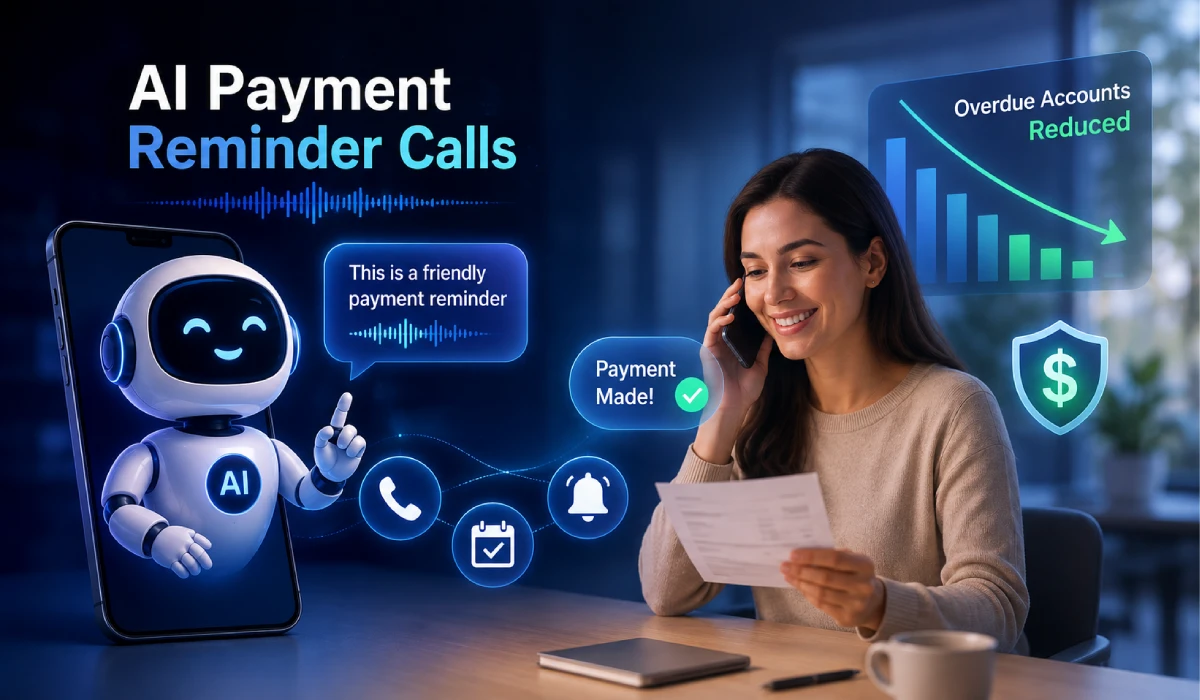
AI payment reminder calls help businesses reduce overdue accounts by automating timely, personalized calls for upcoming and overdue invoices.
They can handle routine follow-ups, capture payment intent, and trigger the next action, helping businesses improve payment collection while reducing the manual workload on accounts receivable teams.
AI payment reminder calls are automated phone calls made by an AI voice agent to remind customers about upcoming, due, or overdue payments.
Instead of having staff manually call each customer, the AI uses information from your billing or CRM system to deliver personalized reminders, answer basic payment-related questions, capture payment intent, and schedule follow-ups.
Unlike a basic recorded message, an AI voice agent can hold a two-way conversation and respond based on what the customer says.
For example, it can confirm when a customer plans to pay, note a request for more time, or flag a dispute for human follow-up. This makes AI payment reminders more conversational and useful than one-way notifications.
AI payment reminder calls typically follow an automated workflow that connects your billing or CRM data with an AI voice agent.
The system checks invoice details, due dates, outstanding balances, and customer information.
Businesses can set calls before the due date or trigger follow-ups once an invoice becomes overdue.
The AI voice agent contacts the customer and communicates details such as the invoice amount, due date, or outstanding balance in a natural conversation.
Instead of simply playing a recording, the AI can identify whether the customer intends to pay, needs more time, has a question, or wants to dispute the invoice.
Based on the conversation, the system can schedule another reminder, record a promise to pay, send a payment link through another channel, or escalate the account to a human team member.
Call results, customer responses, payment commitments, and follow-ups can be logged automatically, giving accounts receivable teams better visibility into their collection efforts.
Automated payment reminder calls can make a real difference when overdue invoices start piling up.
The 2025 Intuit QuickBooks Small Business Late Payments Report found that 56% of U.S. small businesses were owed money from unpaid invoices, with an average of $17,500 outstanding per business.
Even more concerning, 47% had invoices that were more than 30 days overdue.
Businesses with higher levels of overdue invoices were also 1.4 times more likely to report cash-flow problems.
That is where AI payment reminders become useful. Rather than having employees spend hours checking invoices, dialing customers, leaving voicemails, and repeating the same follow-up, an AI voice agent can handle routine payment conversations automatically.
Here are some of the biggest benefits:
A payment reminder is most useful when it reaches the customer at the right time.
AI payment reminders can be scheduled before the due date and automatically continue with follow-ups when an invoice becomes overdue.
This gives businesses a structured process instead of waiting until an account is significantly past due. The goal isn't to pressure customers, it is to make sure a payment doesn't get forgotten.
Manual collections can quickly become time-consuming when a business has hundreds of invoices.
Employees may need to check payment status, identify overdue accounts, call customers, record responses, and decide when to follow up again.
An AI voice agent can handle these repetitive steps automatically. Your accounts receivable team can then spend more time resolving invoice disputes, handling high-value accounts, and working with customers who actually need human assistance.
Customers are more likely to respond when a reminder gives them useful information rather than sounding like a generic automated message.
AI can use available account information to personalise the conversation around details such as the customer's name, invoice status, payment due date, or outstanding amount.
This makes AI customer communication feel more relevant while keeping the process automated.
One missed reminder can turn into weeks of waiting. A defined payment reminder automation workflow can trigger calls at different stages, for example, before the due date, shortly after it passes, and again if the customer doesn't respond.
That consistency matters because businesses don't have to rely on employees remembering which customer needs a call next.
A traditional reminder may simply tell a customer that their payment is due. A conversational AI voice agent can go one step further by capturing the customer's response.
For example, a customer might say they will pay tomorrow, need a few more days, have already made the payment, or believe there is an issue with the invoice.
The system can record that response and trigger the appropriate next step rather than treating every overdue account the same way.
As invoice volume grows, manually increasing payment follow-ups can mean increasing staffing costs too.
AI collection calls allow businesses to contact larger customer volumes without putting the same workload on their finance or accounts receivable teams.
This is particularly useful for businesses managing recurring invoices, subscriptions, instalments, or large customer databases.
The Federal Reserve's 2025 Report on Employer Firms found that 51% of small businesses identified uneven cash flow as a financial challenge, while 56% cited paying operating expenses as a challenge.
Automated payment communication doesn't guarantee faster payments, but it can help businesses create a more organised collection process.
When call outcomes, payment commitments, failed attempts, and escalations are recorded automatically, finance teams get a clearer view of what is happening across outstanding accounts.
Perhaps the biggest advantage is the balance between collection and customer experience.
Businesses need to get paid, but repeatedly calling customers can make payment collection feel confrontational.
With AI voice payment reminders, businesses can maintain regular, professional communication without making their employees repeatedly chase the same customers.
AI handles the routine conversations, while human teams step in when a situation requires judgement, empathy, or negotiation.
When payment follow-ups become repetitive, businesses need more than an automated dialler.
They need a reliable way to remind customers, understand their responses, and manage what happens next. That is where Bizfusion can fit naturally into the accounts receivable workflow.
Bizfusion uses AI voice agents to automate billing notifications, payment reminders, overdue balance alerts, and follow-up calls while keeping customer conversations personalised.
Instead of replacing your finance team, it takes care of routine communication so they can focus on disputes, sensitive accounts, and higher-value collection tasks.
Schedule reminders for upcoming bills, due dates, and overdue invoices without manually tracking every account.
The AI can interact with customers, capture responses, identify payment intent, and determine when a conversation needs human attention.
Customer and invoice information can be used to make each reminder more relevant instead of relying on generic recorded messages.
Missed calls, promise-to-pay commitments, and overdue accounts can trigger the next step automatically, helping maintain consistent follow-ups.
Businesses serving customers across different regions can communicate in multiple languages, making payment reminders easier to understand.
Along with voice calls, businesses can use channels such as SMS and WhatsApp to continue payment-related communication where appropriate.
Call outcomes, responses, and collection activity can provide teams with better visibility into their payment reminder campaigns.
AI can manage routine conversations while more complex billing questions, disputes, or sensitive cases can be passed to a human team member.
Overdue payments do not always require more chasing, they require timely and consistent communication.
AI payment reminder calls help businesses automate routine follow-ups, understand customer responses, and keep payment conversations moving without adding more work for their teams.
Bizfusion helps businesses put this approach into practice with AI-powered voice reminders, automated follow-ups, personalised customer communication, and connected channels such as SMS and WhatsApp.
Yes. AI payment reminders can help reduce overdue accounts by delivering timely, consistent follow-ups and capturing payment commitments.
AI voice agents automate repetitive AI collection calls, handle large customer volumes, and provide consistent payment communication without increasing manual workload.
Yes. AI can use customer and invoice information to create personalized conversations based on payment status, due dates, outstanding balances, and customer responses.
Yes. AI debt collection calls for SMBs can help small businesses automate repetitive follow-ups without requiring a large accounts receivable team.
Yes. Bizfusion helps businesses automate billing alerts, payment reminder calls, overdue balance notifications, follow-ups, and customer communication using AI voice technology.
Recent Posts